


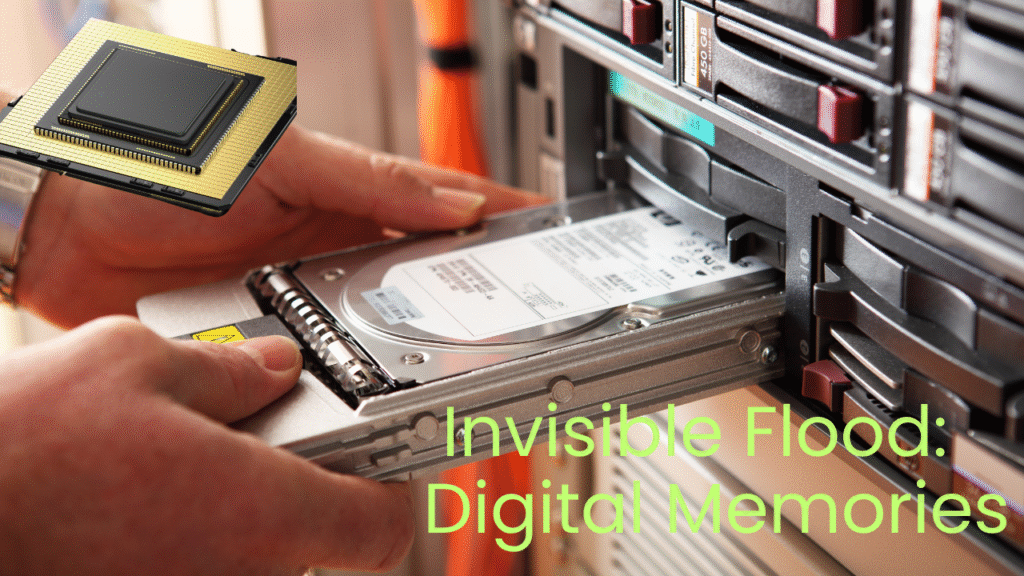
The Invisible Flood: How Our Daily Digital Memories Are Reshaping Technology
Following explains the Invisible Flood: How Our Daily Digital Memories Are Reshaping Technology
Every minute, we(we all internet users) uploads 500 hours of YouTube videos, snaps 150,000 photos, and sends 200 million emails—an unstoppable tsunami of digital memories. Behind this quiet revolution lies an urgent question: Where does all this data live, and how do memory companies keep up with our evergoing demands?
Why We’re Need of Digital Memories
-
Social Media’s Endless Scroll: The average person generates 1.7 MB of data per second—mostly photos, videos, and posts designed for sharing. By 2025, over 70% of smartphone users rely on cloud storage for memory preservation .
-
AI’s Hidden Hunger: Your ChatGPT query? It consumes 10x more memory than a Google search. Training advanced AI models requires memory capacities equivalent to 50,000 smartphones working in unison .
-
The “Smart Everything” Effect: From dashcams needing 64GB microSD cards to drones storing 4K footage, IoT devices will consume 35% of global memory production by 2026 .
How Tech Giants Handle the Memory Crunch
Enterprise Storage Wars
-
HDDs: The Unsung Heroes: Despite slower speeds, hard disk drives remain essential for “cold storage.” Seagate’s new 30TB HAMR drives (using laser-assisted tech) allow data centers to store 7.3 zettabytes by 2029—enough for 30 trillion cat videos .
-
SSDs Take Center Stage: High-capacity 100TB SSDs now compete with HDDs for AI workflows. QLC flash technology cuts costs by 20% but requires careful use due to limited write endurance .
-
Tape’s Surprising Comeback: IBM’s 50TB magnetic tapes (yes, tapes!) archive 43% more efficiently than HDDs with lower carbon emissions—ideal for government/healthcare backups .
Comparison of Enterprise Storage Solutions
| Technology | Capacity | Cost per GB | Best For |
|---|---|---|---|
| HDD (HAMR) | 30-50TB | $0.02 | Bulk cold storage |
| SSD (QLC) | 60-100TB | $0.10 | AI/data centers |
| Magnetic Tape | 50-576TB | $0.01 | Long-term archives |
| HBM Memory | 24GB/speed | $0.80 | AI training chips |
Next-Gen Memory Breakthroughs
Tech giants are quietly revolutionizing memory architecture to handle our digital hoarding:
-
3D Stacking: Samsung’s 300-layer NAND flash crams 20% more data into smartphone storage.
-
MRAM Magic: Embedded magnetoresistive RAM (used in Tesla’s autopilot) offers 100x faster writes than flash with zero power drain during sleep mode
-
Storage-Class Memory: Hybrid solutions like Intel’s Optane blur the line between RAM and storage, accelerating database queries by 8x
What This Means for You: Guard Your Digital Legacy
While corporations build memory “skyscrapers,” individuals risk losing precious data to device failures or format obsolescence. Here’s how to fight back:
-
Embrace the 3-2-1 Rule:
-
3 copies of critical files (original + two backups)
-
2 different media types (e.g., SSD + cloud)
-
1 offsite backup (e.g., cloud or friend’s house)
-
-
Future-Proof Your Formats:
-
Save photos as JPEG/PNG (not proprietary RAW)
-
Use MP4 for videos, PDFs for documents
-
Avoid “dead” formats like Flash or HD-DVD
-
-
Industrial-Grade microSDs: For dashcams/drones, invest in high-endurance cards (e.g., SanDisk Max Endurance). A $65 industrial card lasts 120k hours vs. consumer cards’ 30k
-
Cloud with Caution: Enable two-factor authentication and review permissions yearly. iCloud/OneDrive offer free tiers but charge $10/month for 2TB—cheaper than lost wedding photos .
The Road Ahead: Memory in 2030
As AI generates 50% of internet content by 2030 , memory tech will evolve radically:
-
DNA Storage Trials: Microsoft’s experiments store 1 zettabyte in 1 gram of synthetic DNA—potentially making all human memories fit in a shoebox.
-
Quantum Memory: Universities are developing atomic-level storage with eternal durability (no more “bit rot”)
Your Action Plan
-
Audit Annually: Review stored files every December—delete duplicates, update formats.
-
Go Beyond Google: Use archival tools like iDrive or Backblaze for versioned backups.
-
Demand Better Tech: Support devices with SD Express slots (7x faster transfers) to future-proof your workflow .
The irony? We’re drowning in digital memories while struggling to preserve what matters. As storage expert Tom Coughlin notes: “The real challenge isn’t making more memory—it’s teaching humans to curate their digital souls.”
Your memories deserve more than a dusty corner of the cloud. Guard them fiercely—they’re the only legacy that outlives you.
Sources:-
- https://www.forbes.com/sites/tomcoughlin/2024/12/14/digital-storage-and-memory-projections-for-2025-part-3/
- https://www.coherentmarketinsights.com/blog/insights/top-companies-next-generation-memory-industry-1633
- https://www.sdcard.org/press/thoughtleadership/state-of-memory-technology-and-trends-to-watch-in-2025-2/
- https://www.forbes.com/sites/tomcoughlin/2024/12/06/digital-storage-and-memory-projections-for-2025-part-1/